Tuesday, June 10, 2008

Kassab

Formalities went smooth and it was hot. We had left the highlands and for the coming weeks we had to get used to high temperatures.There were regular police road blocks and our passports were checked several times. But Ed found soon the place where we would spent the night: research centre and hospital Kassab about 30km before Gedaref. From our old friend El Tahir everyone in the hospital people knew that we were coming. He had shown them pictures from 14 years ago! The welcome was very warm and they all looked very well after us. Cold drinks were available and pretty soon we were talking about the ‘old’ days in Um- Kuraa when Ed and Helma were working on a kala azar project. A nice diner was served. We slept outside under a mosquito net. Dr Brima asked if we wanted to use internet. Internet in the middle of nowhere? We were a bit sceptical after our experiences in Ethiopia and we tried our blog. Within seconds it showed on the screen, unbelievable! The boys were happy, meaning that they would be able to play games on the internet again in Khartoum.
The next day we visited the hospital and everyone wanted us to take photographs. It was very impressive. More surprises lay ahead. We went to the market to buy items for our breakfast ´fatuur´, and they even had yoghurt! All soda drinks were available, even our favourite Fanta Black Currant and all kind of nice juices. Things must have changed in the Sudan, would we still recognise Khartoum?

Gonder


Never alone in Ethiopia

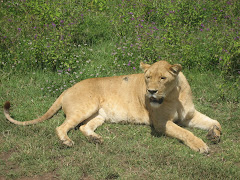
On went the trip to Gonder, the ‘Camelot of Africa’. We had no idea Africa had castles at all. Emperor Fasilidas around 1650 started to build the first castle: the royal enclosure is now in the middle of the city. Every emperor built an additional building, banquet hall, sauna or something else. It was still in a good shape. What was most interesting to us that they kept lions in a separate building. Every ruler used to have his own tame lions, Abyssinian lions, in a special house, called the lion house. Even Haile Selassie had his tame lion and the lions accompanied him on every trip!
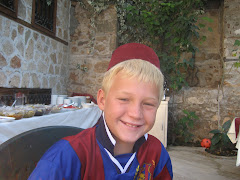
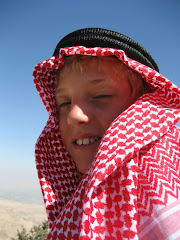
We also went to the royal bath which is still used in January every year. The river will flow through the bath, about 4 meters deep. The water will be blessed by the priest and then all the people jump in the water ! It is an ingenious system because afterwards they let the water flow back to the river. Again our ‘babies’ were free of charge to enter into the bath. Bart and Evert are not too happy by the fact that everyone calls them babies. As you can see on the photo is taking a taxi in Ethiopia always a lot of bargaining and of course are the children watching and shouting :'you, you' and 'babies'.
Lastly we went to Debre Berhan Selassie church which was created around 1690. On the ceiling they painted lots of angels. We thought it was the nicest church we have seen, mainly because the fact that our taxi driver together with the priest tried to show us in very basic English all the paintings on the wall and their meaning. It was really touching. But that was enough. So much for culture and churches. Sudan was waiting.

Debre Berhan Selassie Church and the angels on the ceiling

The trip to the border was again a battle of dust and detours, but we knew tarmac was waiting in the Sudan. The villages we drove through were poor and underdeveloped. The immigration office was in a kind of shed and no computers because there was no electricity. We spent our last Birrs on water and biscuits and crossed the border into the Sudan.

Saturday, June 7, 2008

Lake Tana


Again another 180 km to Bahir Dar and Lake Tana on bad road. But Bahir Dar was a lovely place, with wide lanes and palm trees. And Helma is always pleased to see water. On this lake there are lots of small islands and an each island there is a monastery. We hired a boat and visited 3 monasteries. For the first one we had to walk about 20 minutes through a lovely area with coffee trees, oranges, avocado’s and mango’s. The church was OK but the little museum of all the equipment people used in the past was very nice. We saw how they made the ‘tej’ and played on some instruments. On the second island only men were allowed. From the pictures Helma knew she missed something. In this monastery they kept very old books and ornaments. The monastery on the last island was very small and very new with beautiful drawings. The last stop was the outlet of the Blue Nile; here one says goodbye and wishes the river well on its trip to the Mediterranean Sea, a trip of more than 5000 km. We would see it again in Khartoum. It was already an impressive river and the current was enormous. Luckily we were sitting in a motor boat otherwise it would have been impossible to reach the hotel again. On the lake we saw again lots of pelicans. Some boats were really exotic made from straw as they must have done thousands years ago. Children sold mini boats made from straw to tourists. We thought the real one was much better.
At the hotel Bart was followed by a nice monkey. At first he was a bit afraid, but later on he didn’t mind even if the little creature jumped on his head. No picture available, the camera was not stand by.

Due to the public holiday we stayed at the hotel where we had a good view on the lake, for a boat show. Unfortunately it was cancelled due to high winds. Never mind, we enjoyed and played a lot of Cluedo and cards.
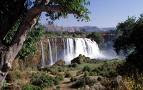
Not far away were the Blue Nile Falls. But after seeing the Vic falls, we decided to give it a miss because people warned us it was not so impressive anymore. They built an electricity plant and that reduced the width of the falls enormously.

some more photo's

Priest at the church

Tired??


Friday, June 6, 2008

Evert on the mule


Lalibela - 2


Monday 26 May
Then it was our turn to have some fun. The night before we arranged for a trip with mule donkeys which would bring us up the mountain to the church and back. At first I thought the donkeys couldn’t do it, but they did, all the way! We did have to walk a few bits but mostly they carried us. Of course my mum didn’t participate, because she was scared of heights and falling off, but dad did. It was a good thing she wasn´t around because it was sometimes really scary. Amazing really but they carried us on the top of cliffs, we could almost fall down! The church wasn’t much, but it was king Lalibela´s first rock hewn church. Going down we walked most of the way. And not to forget Evert´s donkey was the fastest, mine got the whip a few times but it was ok. These Mules are much more comfortable than a horse but not faster. It was fantastic. Yes indeed!
Bart

Lalibela-1


On our way to Lalibela, the place of the rock hewn churches, we were again confronted with detours, road constructions and dust eating. The Chinese are everywhere in Africa, constructing new roads. We saw them in Malawi, Kenya and now in Ethiopia. We also realised that we have made this trip a little bit too early; in five years time the whole road from Cairo to Cape town will be tarmac. Never mind, we just continued. The views were excellent although we had again our regular traffic jams due to the cattle.
On Saturday 24 May we reached Lalibela after a climb of more than 2 KM. The views were stunning. On top of the plateau again Chinese to fix the road, but compared to what we have been through we could only comment that the road was not too bad. The last 20 K were even tarmac. That was the airport road. People who are flying in have no idea what an achievement it was to arrive in Lalibela by road.
Lalibela, also known as the second Jerusalem of Africa, was the capital of Ethiopia in the 12th and 13th centuries. King Lalibela had either a vision, or had been in Jerusalem, history is not clear about that, that he wanted to create a new Jerusalem for all Ethiopians to visit. It is very isolated ( it took us 2 days) and on 2630meters high. Nowadays it is a World Heritage Site. And we have to agree, it is very impressive. It is the centre for pilgrimage for many Ethiopian Orthodox Christians.
In total there are about 11 churches which are connected by tunnels. Unfortunately most tunnels are closed now, but the one we have seen was quite scary and pitch-black. Every rock hewn church has a priest and every church has its own cross. Some had a very nice interior with paintings, others were just impressive as such. You see us in front of Bet Giyorgis, the masterpiece, a church in the shape of a cross. Around the church there are many caves for pilgrims. We were a bit shocked when we saw three mummified corpses of pilgrims from the 16th century. The guide told us all about the special meanings of the crosses and the drawings and so on. It was a very interesting tour, well worth the trip.